Living in a village with no lights in a part of the world where the sun sets at 6:00 pm has a great effect on the body. Dinner is eaten by candlelight and any reading or journal writing is done with the help of a flashlight or headlamp. More importantly, it means that you are usually in bed by 8:00 pm. The body feels like it’s time to go to sleep and without all the usual hullabaloo of a western lifestyle, there’s really no point in arguing with your body.
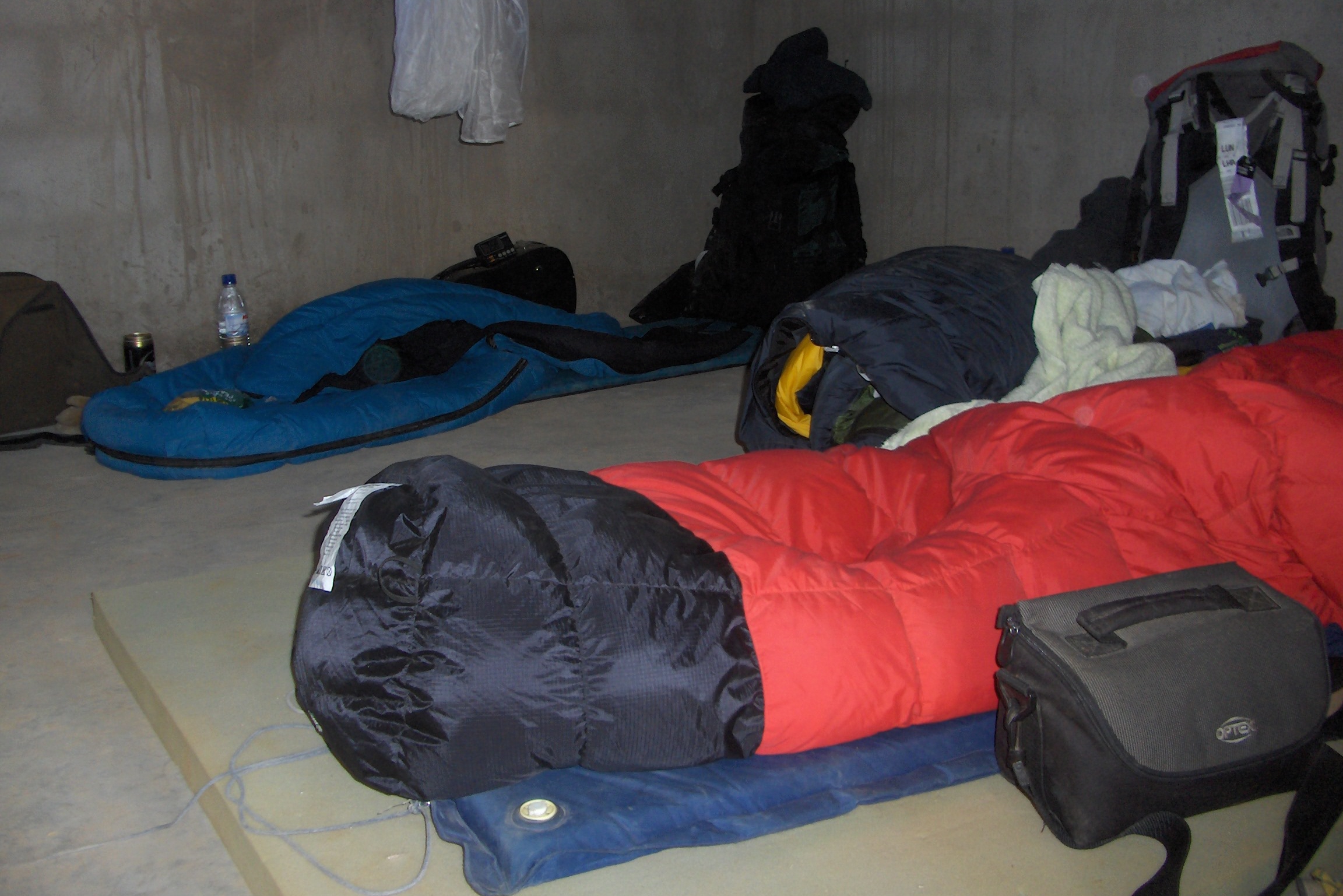
Only one house in all of Tiyende Pamodzi has electricity and that’s the home of Jonathan, the foreman of the building project. Powerlines are available for all to have electricity, but the rule is you cannot have hookups until you pay off your mortgage. This policy encourages homeowners to pay off their mortgages faster (which helps fund the construction of more houses) and ensures that homeowners do not take on more expenses than they can handle. Everything in this country operates on pre-payment. There is virtually no credit available. This means you purchase so many units of electricity for the month, similar to a phone card for a mobile phone.
It is strange to be living in a village with no electricity that is surrounded by other villages that have it. Power allows the unlicenced bar across the
highway from us to play loud music all night long, disturbing its slumbering neighbours. It also provides a constant reminder to this area that
inhabitants of Tiyende Pamodzi are newcomers here.
The villagers also have other reminders of their “outsider” status in this area. For instance, the parents of Tiyende Pamodzi must send their kids 2
hours away (on foot) to go to school because there are no schools in the immediate area that will take them. This means that for students who are in the morning session (the school day is divided in two) they must leave at 5:45 in the morning while it is still dark and cross Zambia’s busiest highway to get to the road that takes them to school. It means that the afternoon students are not returning home until nearly 7:00 pm in the dark.
THE MEALS
We have 3 women assigned to us to prepare meals, provde us hot water for washing, washing our clothes and occasionally sweeping out our houses. Their cooking skills are beyond anything I expected considering the limited facilities they are working with. For one, they only have a charcoal “stove” to work with.
So far, they have whipped up selections of both western and local favourites. The other night we had pasta with a combination of store-bought tomato sauce and improvised ingredients. They can do things with cabbage that would embarrass even the finest Ukrainian cook. Another night we were treated to a local staple, chima, with vegetables in sauce. Chima is made from maize and looks a lot like couscous. You scoop it up with your hands and use it as a spoon to scoop up the vegetables.
Last Monday, it was decided that we should have chicken with supper. Dennis (our team leader) went with one of the women who cook for us to the nearby market to find 4 live specimens.

Imagine, the price for 4 live chickens was the equivalent of $28 US! No wonder people in this part of the world cannot afford to eat much meat. Jonathan, our foreman who lives in the village did the honours of executing our 4 dinner “guests”. I had a strange realization that that was the first time I had ever seen the slaughter of an animal. A number of us gringos gawked as the procedure took place, prompting Maridon, one of our cooks who is quite funny and outspoken to say jokingly, “You know, those chickens don’t grow in a
supermarket!”
The chicken was excellent that night. They were cut into large and small pieces and fried in oil and spiced just nicely. I have noticed that Zambians love their salt.

One night, 4 guys from the team including myself decided to ditch the rest of the team and headed into Lusaka to have supper out. Ironically, we intended to eat out to have something different than what we were eating at the village, but instead opted for a restaurant that served chima and local cuisine. Two of us ordered chicken curry and the other 2 had beef stew. All plates came with ample serving and delicious cabbage. The whole meal, with drinks, came to a paltry $21 US. This is a steal in a country that has become incredibly expensive in the last couple of years.
MAYHEM ON THE GREAT NORTH ROAD
As I mentioned, the village sits astride the most important highway artery in Zambia. The Great North Road connects Lusaka with Zambia’s richest economic zone, the Copperbelt district, which is known for guess what…copper mines. The importance of the highway means there is truck traffic day and night. Sometimes, the heavy truck traffic can have disastrous results.
On Friday morning while we were eating breakfast, a tanker truck carrying diesel fuel overturned on the highway just a couple of hundred metres from where we are staying. Apparently the driver was trying to overtake a car but misjudged the amount of time before an oncoming vehicle approached. He cut back into his lane hard and jack-knifed the truck which caused it to overturn. What has followed has been an interesting
lesson in anthropology and economics.
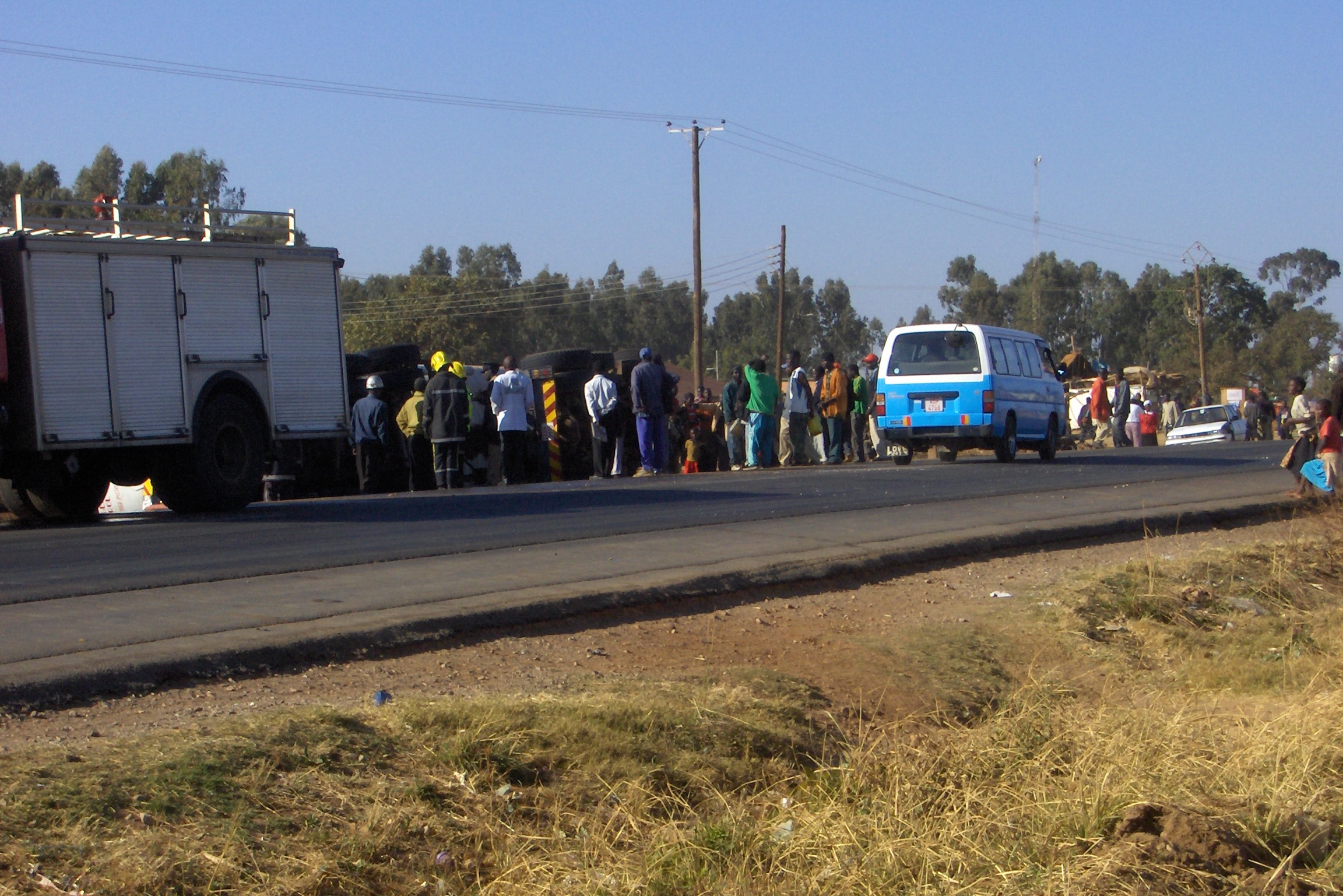
With diesel fuel pouring out of the truck, at least a hundred or so locals have converged on the site to scoop up all the vile smelling “liquid gold” they could. Containers normally used by families to collect water at wells were suddenly fuel tanks. They were only vaguely aware, apparently, of the contamination the diesel would cause. One woman carrying 2 10 litre water containers filled with diesel from the site told our team leader “I’m rich! I’m rich” Hmmm…The price of diesel here is 4,500 Kwacha per litre or $1.50 US. She could probably get $15-20 for her windfall which is probably a couple weeks’ income here.
The tragedy is that families will now hve containers of diesel in their homes until they can sell (to whom???). What will they use to get water today and for the next couple of days? Will the kids who were scooping diesel with their bare hands know enough to wash off? What contamination to ground water will occur? Will the wells at Tiyende Pamodzi be poisoned? That morning, the people of Tiyende Pamodzi and the surrounding communities got a windfall. Are they aware of the potential long term impacts of this?
THE BUILD CONTINUES
There have been some significant organizational problems with this build. Delays in the delivery of cement blocks means that our progress has been curtailed. On Thursday, we were supposed to get blocks in order to continue building, but they never arrived. This delay set us back an entire day, since the local builders did not plan an alternate site for us to work in the case of such an eventuality.
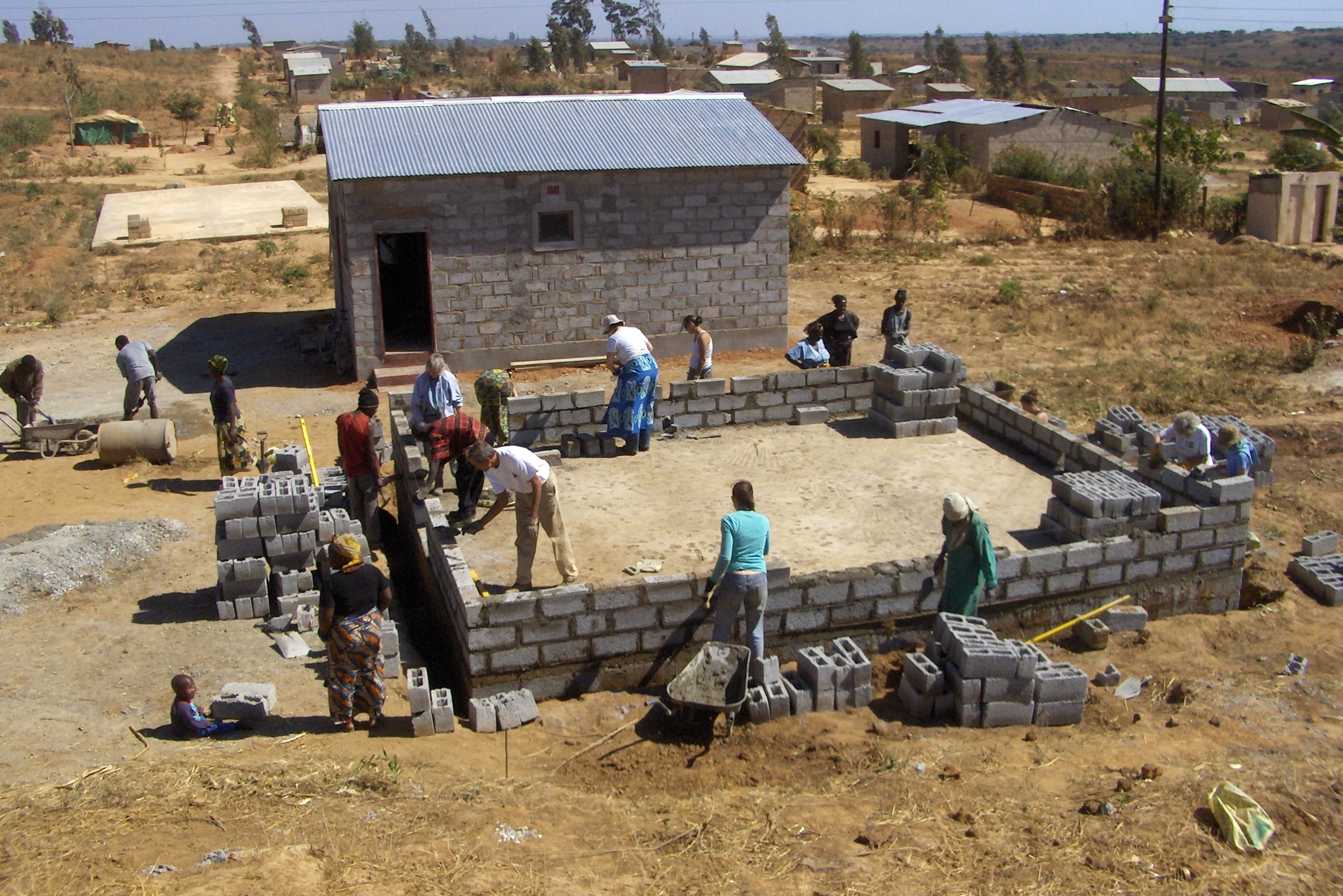

The blocks finally arrived at 10:00 on Friday to relief of everyone. By the end of the afternoon we were able to erect the walls up to the level of the
windows.
My back bothered me the last couple of days of the build, but somehow I always got stuck with the most back breaking job…mixing mortar and filling wheelbarrows. Fortunately in the last couple of days the back problem has subsided.
Saturday was our last day of building. At noon we broke and took pictures of ourselves at the house and of the builders. Despite the delays, we managed to accomplish quite a lot. We worked on two houses, nearly finishing one that had been started before we arrived (all is left is plastering the interior walls) and building a second one from scratch to about the 2/3 point. All that is left is remaining few feet of walls and the roof.
During Saturday afternoon we packed up our stuff and made the initial triage of what personal items would stay behind and what should go with us. I have managed to offlaod my duffle bag with its contents of donated children’s clothing school supplies soccer balls and frisbees. I still have the fiddle to figure out. It looks like one of my teammates may purchase it. He is 70 and played violin for a short while in high school. Perhaps he’s found some inspiration to pick it up again.
Also during that afternoon, the local women had a sale of their handmade goods for us to buy. The prices were rather high and there was no haggling. I limited myself to a couple of items that would pack easily. I at least wanted to buy something just to support their incomes a little.
At 4:00 we reconvened with the villagers and builders for a “closing ceremony”. Everyone came out for it. Maridon, the woman who cooks for us, even arranged to have her church choir come out for the occasion.
The children were dressed up and everyone participated. The Habitat volunteers presented gifts of groceries to the cooks and community members who played key roles in the build. The builders were each presented with gifts of donated tools from us as well as our used work boots, which are highly valued. The choir sang, the children danced and sang and everyone felt like celebrating.

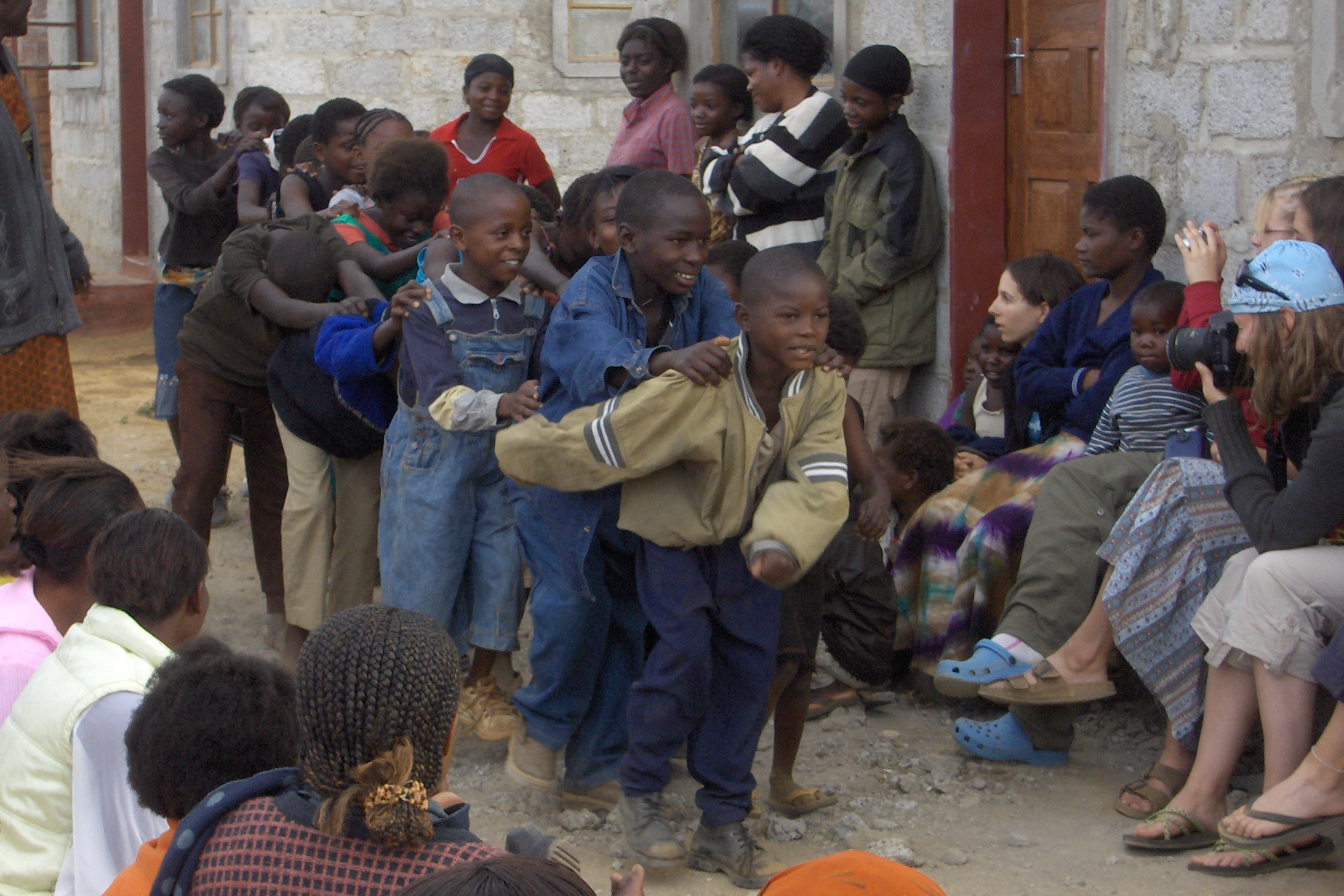
Our team was also expected to sing, which was a something announced to us only that afternoon. What song could the Americans and Canadians of our group pick that we would all know??? National anthems are tacky. Someone suggested Amazing Grace. Ok what the hell. With all the dust and dirt on us, we made pretty fine wretches to be saved. A last minute addition to the celebration was a request by the village kids for me to play a fiddle tune. So I ran into the house, pulled out the violin and played a set of Cape Breton jigs and the crowd burst into dance. How crazy is that?
FAREWELL
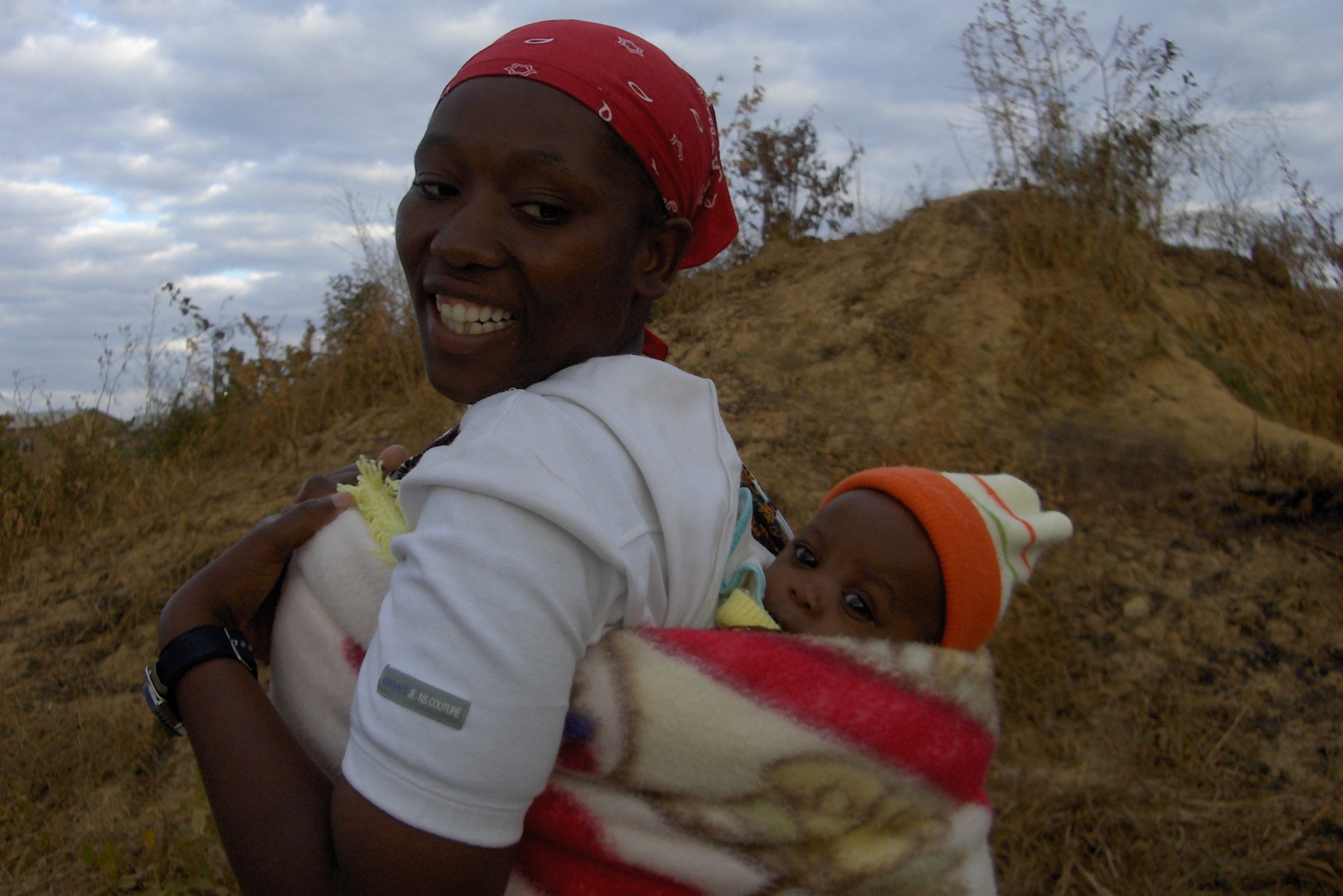
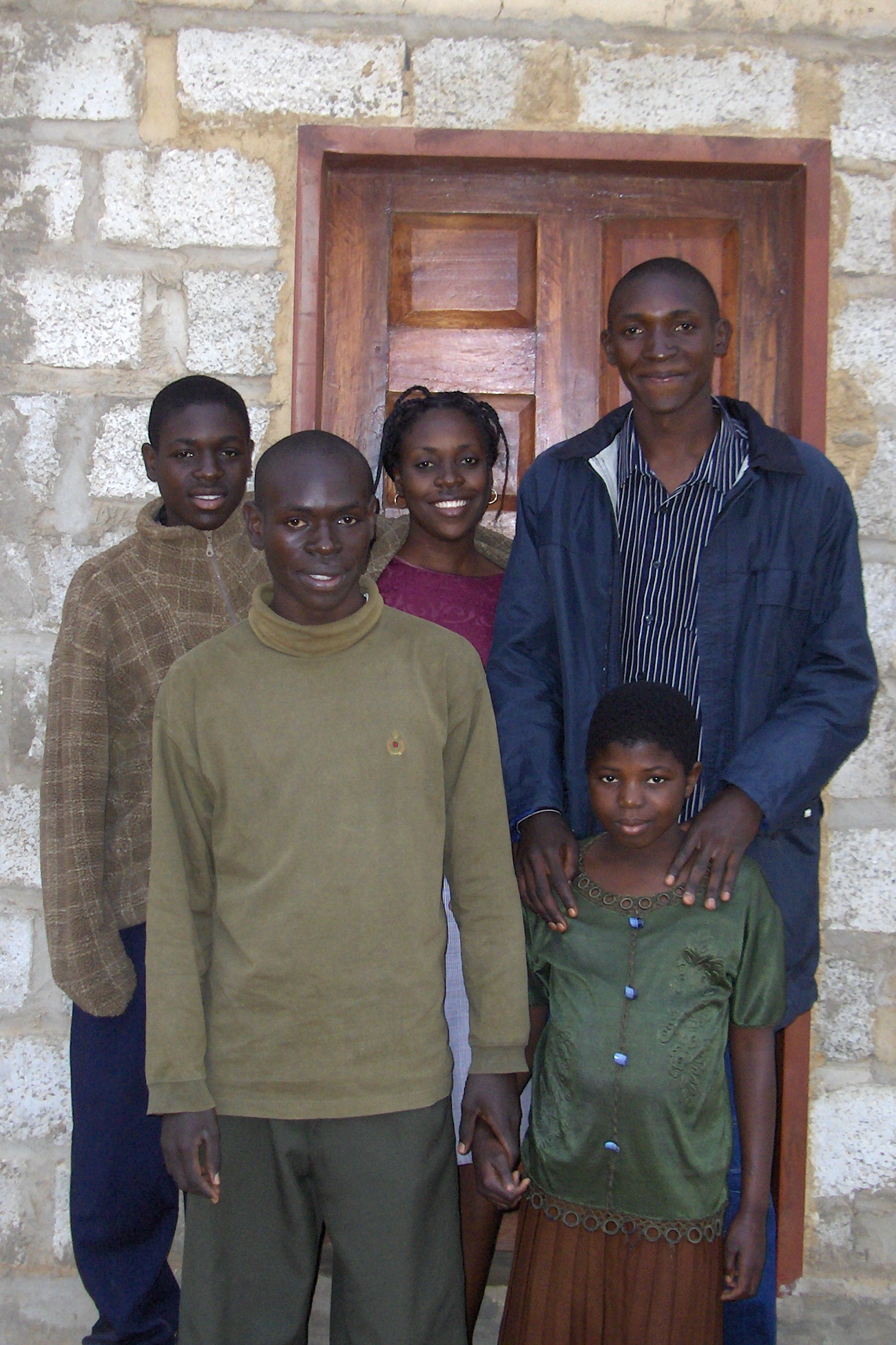
On Sunday morning, we awoke at the break of dawn for our 6:30 bus to Livingstone for 2 days of rest and relaxation. With sleep still in our eyes, we dragged our bags out of the house and were greeted by several members of the village committee to see us off. We were very pleasantly surprised to see 15 of the children come out…all our favourite kids too, like Jonah, Memory, Esther and little Lloyd. They were all looking pretty somber. It was very hard to say goodbye to those lovable little faces, some of them too young to really understand that we would most likely never see them again, others old enough to know this all too well.
For the last 10 days, these wonderful people have welcomed us into their lives and shared with us in everyway they could. Hugs were exchanged all around. Even Lloyd, who is always SOOOO serious and sad and shy gave me a hug. Then we drove off and watched as Tiyende Pamodzi disappeared behind us.
 sedativegunk